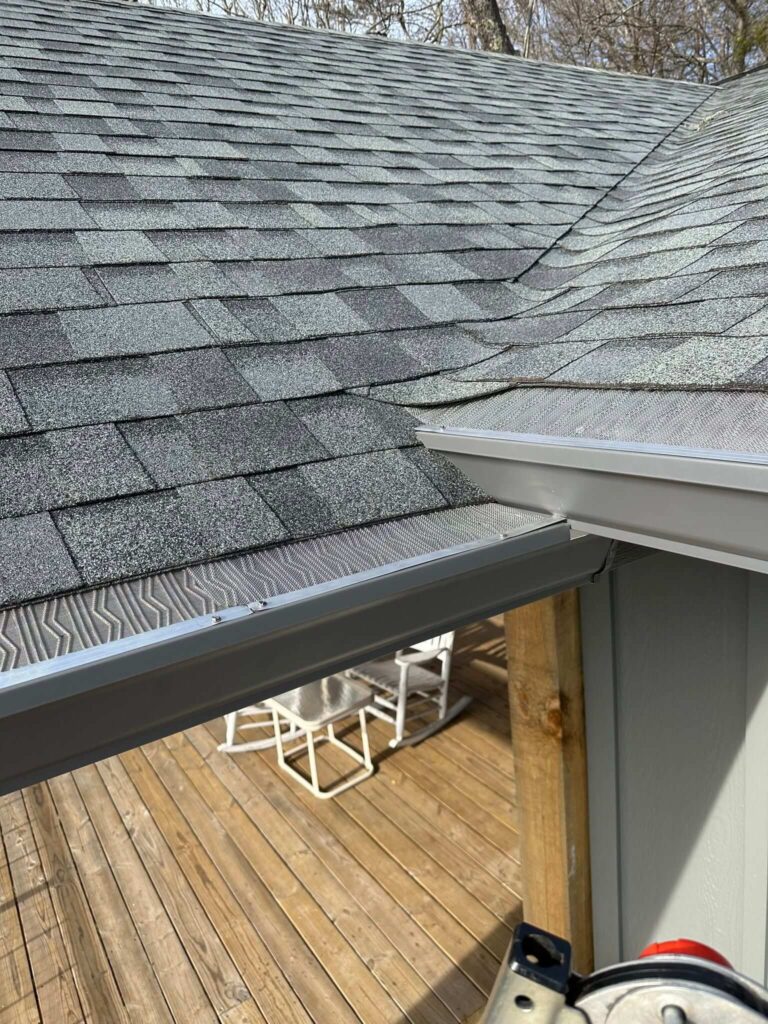
In our experience, most homeowners with pine and hardwood trees extending over the roofline are clearing their gutters three or four times a year. Pine needles, leaves, seed pods, and small twigs can accumulate quickly, especially after storms or in the fall, slowing water flow and sometimes blocking a downspout.
After dealing with the same problem repeatedly, many homeowners start looking at gutter guards as a way to reduce the buildup and cut down on maintenance. A good gutter guard system should allow rainwater into the gutter while keeping most larger debris out.
However, gutter guards are not completely maintenance-free. Whether they are worth installing depends on the type of debris around your home, the condition of the existing gutter system, the roofline, and the type of guard being considered.
In this guide, we will explain what gutter guards actually do, compare the most common types, and share the pros and cons to help you decide whether they are worth the cost.
What Do Gutter Guards Actually Do?
A gutter guard covers the top of the gutter and filters what reaches the trough. This helps rainwater to pass through the openings and continue toward the downspouts, leaving leaves, pine needles, seed pods, and small twigs on top of the system.
When the guard is suited to the type of debris around the home, it can extend the time between cleanings and help the gutters continue draining during the times of year when leaves and needles fall most heavily. A homeowner who normally clears the gutters three or four times a year may still need maintenance, but often less frequently.
For homeowners who do not regularly climb a ladder, fewer trips to the gutter can be one of the most practical reasons to install guards.
Gutter guards can also reduce the amount of wet, compacted debris in the trough. That may help limit standing water and the sheltered areas that insects, birds, and other pests sometimes use as nesting sites.
However, these guards do not eliminate gutter maintenance. In many cases, the debris that once collected inside the gutter now collects on top of the guard. Some of it may blow away or wash off, but leaves and needles can also mat together after rain, restricting how quickly water enters the gutter.
Pollen, shingle granules, dirt, and small needle fragments can settle in the trough beneath the guard. Depending on the system, cleaning this material may require lifting or removing sections of the guard first.
Gutter guards also cannot correct an existing drainage problem. Gutters that are undersized, improperly sloped, pulling away from the fascia, or connected to clogged downspouts will still need to be repaired before a guard can perform properly.
The results depend heavily on matching the system to the roof, the surrounding trees, and the type of debris falling on the home.
Types of Gutter Guards
Most gutter guards operate on the same basic principle, but the materials, opening sizes, and the way they direct water can differ significantly. Some are better at stopping large leaves, while others are designed to filter pine needles, seeds, and smaller debris.
The right option depends on what is falling onto the roof, how steep the roof is, how much rainwater reaches the gutter, and how easily the system can be cleaned later.
Screen Gutter Guards
Screen guards use metal or plastic panels with openings that allow water to enter the gutter while blocking larger leaves and twigs. They are one of the simpler and more affordable options and can work well on homes that mainly deal with broad leaves.
The larger openings are also their main limitation. Pine needles, seeds, roof granules, and smaller debris can pass through the screen or become lodged in it. Leaves may also collect on top if the screen is flat or installed without enough slope.
Micro-Mesh Gutter Guards
Micro-mesh guards use a much finer screen than standard gutter screens. The small openings are designed to keep out leaves, pine needles, seeds, and many of the smaller particles that pass through basic screens.
These systems are often a better fit for homes with mixed tree cover, but the surface still needs occasional cleaning. Fine pollen, dirt, and organic material can settle into the mesh, and water may begin running over the edge if enough debris mats across the top.
Reverse-Curve Gutter Guards
Reverse-curve guards, sometimes called surface-tension guards, use a solid cover with a curved edge. Rainwater follows the curve into a narrow opening while leaves and other debris are intended to fall over the side.
These guards can keep a large amount of debris out of the gutter, but their performance depends on the roof pitch, water volume, and installation. During heavy rain, water may move too quickly to follow the curve and can overshoot the gutter. The narrow opening may also collect smaller debris over time.
Foam Gutter Guards
Foam guards fit directly inside the gutter and leave the top surface exposed. Rainwater passes through the porous material, while leaves and larger debris remain above it.
They are relatively easy to install, but fine debris can settle into the foam and be difficult to remove. Seeds may also take root in the trapped organic material, and the foam can deteriorate over time depending on the product and conditions.
Brush Gutter Guards
Brush guards sit inside the gutter and use upright bristles to stop larger debris from settling into the trough. Water flows around the bristles and continues toward the downspout.
They are simple to install and remove, but leaves, pine needles, and seed pods can become caught between the bristles. Instead of preventing maintenance, they may change the job into pulling debris out of the brush.
A guard that handles large hardwood leaves may still struggle under pine trees, while a fine mesh that filters smaller debris may require more surface cleaning. The most useful system is usually the one that makes it easy to clear debris that falls onto the roof, not the one that makes the broadest maintenance claims.
Pros of Gutter Guards
The main benefit of gutter guards is not that they eliminate the need for gutter maintenance. It is that they can reduce how quickly debris builds up and help the system continue draining during the times of year when leaves and pine needles are falling most heavily.
A properly selected system can offer several practical advantages:
They Can Reduce How Often Gutters Need Cleaning
For many homeowners, this is the biggest reason to install gutter guards. A home that normally requires three or four cleanings a year may still need to be inspected and cleared, but the intervals between full cleanings can be longer.
Instead of removing packed leaves and debris from inside the trough several times a year, maintenance may involve clearing material from the top of the guard and checking that water is still entering the gutter properly.
They Help Prevent Large Clogs
Leaves, twigs, and seed pods can collect around the gutter outlets and block water from reaching the downspouts. Once that happens, water begins to back up and spill over the edge.
Gutter guards can keep much of this larger debris out of the trough, reducing the chance of a complete blockage. This can be especially useful during the fall or after a storm, when a large amount of debris may reach the roof in a short period.
They Can Help Gutters Keep Flowing During Heavy Debris Fall
Around Seneca, a mixture of pine needles and hardwood leaves can quickly fill an open gutter. If that buildup happens during a period of heavy rain, the gutter may overflow before the homeowner realizes there is a problem.
A guard that is matched to the surrounding trees can help keep the water path open during these heavier debris periods. It still needs to accept water quickly enough for the roof and rainfall, but keeping larger material out gives the gutter a better chance of continuing to drain.
They Reduce the Need to Climb a Ladder
Cleaning gutters can be difficult and unsafe, particularly on two-story homes, steep lots, or rooflines with several corners and elevations.
Gutter guards do not remove the need for maintenance, but reducing the number of times someone needs to reach the gutters can make a meaningful difference.
For homeowners who should not be climbing a ladder at all, fewer cleanings may be enough to justify part of the installation cost.
They Can Help Protect Downspouts
Leaves, pine needles, and twigs can be carried toward the downspout, where they may lodge inside an elbow or move into an underground drainage line.
Those blockages are often more difficult to locate and clear than debris sitting in an open gutter. By limiting how much material enters the system, gutter guards may reduce the chance of downspout clogs as well.
They May Reduce Standing Water and Pest Activity
Packed debris can hold moisture inside the gutter long after the rain stops. In some cases, that creates standing water and sheltered areas where mosquitoes, wasps, birds, or other pests may gather or begin nesting.
Gutter guards cannot prevent every pest problem, but keeping large amounts of wet debris out of the trough can make the gutter less attractive as a nesting or breeding area.
These benefits can make gutter guards worthwhile on the right home, but they need to be weighed against the added cost, continued maintenance, and limitations of each system.
Cons of Gutter Guards
Gutter guards can reduce debris buildup, but they also add another surface that needs to be inspected and maintained.
The main drawback is that they do not completely eliminate gutter problems. In some cases, they simply change where debris collects and how cleaning is done.
They Do Not Eliminate Gutter Cleaning
Even a well-performing gutter guard still needs periodic attention. Leaves, pine needles, pollen, and dirt can collect on top of the guard and restrict how quickly water reaches the gutter.
Some debris may blow away during dry weather, but material that gets wet can mat together and remain in place. When that happens, the surface needs to be cleared before water begins running over the edge.
Fine Debris Can Still Get Through
Micro-mesh systems can block much smaller material than basic screens, but no guard keeps out everything. Shingle granules, pollen, dust, and small needle fragments may still enter the gutter over time.
Once that material settles beneath the guard, cleaning can become more difficult because sections of the system may need to be lifted or removed first.
Water May Overshoot During Heavy Rain
A gutter guard needs to do two things at once. It must block debris while still allowing enough water to flow from the roof.
During a heavy Upstate storm, water can move quickly down a steep roof. If the guard is clogged, installed at the wrong angle, or not designed to handle the volume, rainwater may run across the surface and spill over the front of the gutter.
This can make it look like the gutter is clogged even when the trough itself is relatively clear.
The Wrong Guard Can Make Maintenance Harder
A system that is poorly matched to the debris around the home may create more work rather than less. Brush guards can trap pine needles between the bristles, foam inserts can hold fine organic material, and large screens may allow smaller debris to collect underneath.
When homeowners are unhappy with gutter guards, the problem is often not that all guards fail. It is that the selected design does not fit what is actually falling onto the roof.
They Add Upfront Cost
Professional gutter guard systems can add a significant amount to the cost of the gutter installation. Whether that expense makes sense depends on how often the gutters currently need cleaning and how difficult they are to access.
For a home with little tree cover and easy-to-reach gutters, routine cleaning may cost less over time. On a two-story home surrounded by pine and hardwood trees, the reduced maintenance may be more valuable.
They Can Complicate Gutter and Roof Repairs
Some gutter guards cover the fasteners, gutter edge, fascia, or lower portion of the roof. If the gutter begins pulling away, develops a leak, or needs to be resealed, sections of the guard may need to be removed before the problem can be inspected.
Products that slide beneath the shingles also need to be installed carefully. Lifting or disturbing the roof edge can create problems when the system is not designed or installed correctly.
They Can Hide Existing Drainage Problems
Gutter guards cannot fix an undersized gutter, poor slope, loose hangers, damaged fascia, or a clogged underground drain. In some cases, the cover makes it harder for the homeowner to see what is happening inside the system.
That is why the gutters and downspouts should be inspected and cleaned before guards are installed. Covering an existing problem does not prevent it from getting worse.
These limitations do not mean gutter guards are a poor investment. They mean the system needs to be chosen carefully, installed properly, and maintained with realistic expectations.
How Much Do Gutter Guards Cost?
Most companies price gutter guards by the linear foot, so the total depends largely on the amount of guttering around the home.
For materials alone, gutter guards may cost anywhere from about $0.50 to more than $10 per linear foot. Professionally installed systems typically range from $15 to $45 per linear foot, including labor and materials.
For a home with approximately 200 linear feet of gutters, that could place the total between $3,000 and $9,000, although some installations fall outside that range.
Approximate material costs by guard type include:
| Gutter guard type | Typical material cost per linear foot |
|---|---|
| Plastic screen | $0.50–$1 |
| Perforated aluminum | $0.50–$2 |
| Foam | $1.50–$3.50 |
| Brush | $2–$4 |
| Micro-mesh | $2–$5 |
| Steel screen | $1.50–$5 |
| Reverse-curve | $3.50–$10+ |
These figures cover the guard material rather than the full installed price. Labor can add several dollars per linear foot and may cost more on a two-story home, a steep roofline, or a property where sections of the gutter are difficult to reach.
The condition of the existing gutter system also affects the estimate. Before guards are installed, the gutters may need to be cleaned, resealed, rehung, or corrected for improper slope. Damaged fascia, clogged downspouts, or deteriorated gutters can complicate the project, as those problems should be addressed before the system is covered.
Homeowners should look closely at what the estimate includes. Some prices cover only the guards and installation, while others include gutter cleaning, minor repairs, new hangers, downspout clearing, or a product and workmanship warranty.
The best way to judge the cost is to compare it with the amount currently spent on gutter cleaning, how difficult the gutters are to access, and how long the chosen guard is expected to last.
Are Gutter Guards Worth It?
Gutter guards are usually worth considering when the gutters fill several times a year, the home sits beneath pine or hardwood trees, or the roofline is difficult to reach safely. In those situations, reducing three or four full cleanings to one or two lighter maintenance visits can provide real value.
For many homes around Seneca, the deciding factor is the type of debris falling on the roof. A properly selected micro-mesh or screen system may reduce leaf and needle buildup considerably. A guard that is poorly matched to the property, however, may still clog, allow fine debris through, or require frequent cleaning across the surface.
They are less likely to be worth the cost on homes with little tree cover, easy-to-reach gutters, or systems that only need occasional cleaning. Homeowners should also be cautious about installing guards over gutters that are already damaged, undersized, improperly sloped, or pulling away from the fascia. A guard will not correct those problems and may make them harder to see.
In our experience, the homeowners who are happiest with gutter guards are those who see them as a way to reduce maintenance rather than eliminate it. The right system can help keep the gutters clearer during heavy leaf fall, reduce the risk of larger clogs, and reduce the number of times someone needs to climb a ladder.
The value ultimately comes down to whether the savings in cleaning, time, and risk justify the upfront cost for that particular home. Before installing guards, it is worth having the gutters inspected and comparing the available systems based on the roofline, surrounding trees, and the debris they will actually need to handle.
Should You Install Gutter Guards?
Gutter guards can be a worthwhile investment when a home is surrounded by pine and hardwood trees, the gutters clog several times a year, or the roofline is difficult to reach safely. The right system can reduce debris buildup, help prevent larger blockages, and cut down on how often the gutters need cleaning.
However, they are not a permanent solution to every gutter problem. Guards still need occasional cleaning, and their performance depends heavily on choosing a design that can handle the leaves, pine needles, pollen, and roof debris around the property.
Before installing gutter guards, the existing system should be inspected for poor slope, loose sections, leaking joints, damaged fascia, and clogged downspouts. Covering the gutters without correcting those problems first can make future drainage issues more difficult to identify.
Sure Flow helps homeowners in Seneca and the surrounding Upstate area inspect, repair, and improve their gutter systems. We can evaluate the roofline, surrounding trees, and current drainage problems before recommending whether gutter guards make sense for your home.
Contact Sure Flow Gutters today or call (864)539-6903 to schedule a gutter inspection and get an honest recommendation based on what your property actually needs.