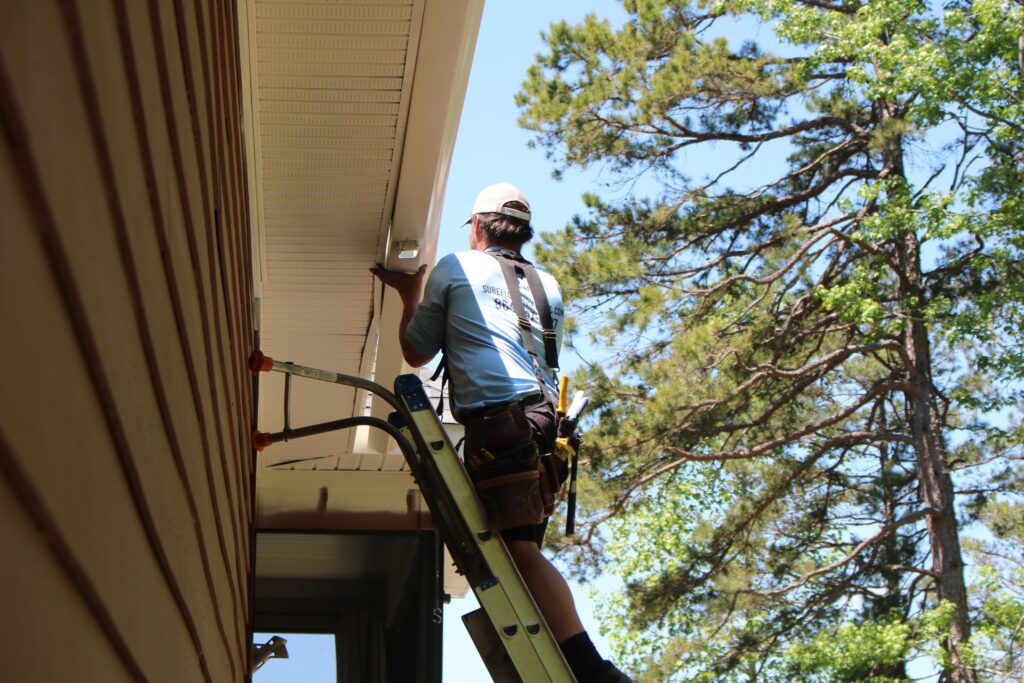
At SureFlow Gutters, we’re a family-owned gutter company serving Seneca, Greenville, and the rest of Upstate South Carolina for the last several years. We’ve installed gutters on hundreds of homes across the area, and we’ve also gotten plenty of calls from homeowners who hired someone else and ended up with standing water, leaking seams, or gutters pulling away from the fascia within a year or two.
Every gutter installer you call will tell you they do great work, but the prices will vary, the materials won’t always match, and one company’s estimate might include things another leaves out entirely. Without knowing what to ask and what a good answer actually sounds like, it’s easy to hire the wrong company and not realize it until the first heavy rain.
A properly installed gutter system should protect your home for 20 to 30 years, while a poorly installed one can cause foundation damage, fascia rot, and standing water problems that cost far more than the original job.
We put this guide together because homeowners who ask the right questions end up with better gutters, fewer surprises, and a company they actually trust. Even if you don’t hire us, these are the questions worth asking before you sign anything.
Questions About the Company and Its Crew
Before you get into the details of materials, sizing, or pricing, it’s worth spending a few minutes on the company itself. The best gutter system in the world won’t matter much if the crew installing it cuts corners or the company behind them disappears when something goes wrong.
These questions help you figure out who you’re actually hiring.
1. Are You Licensed and Insured, and Can I See Proof?
This is the first question you should ask any gutter company, and it should be the easiest one for them to answer. A reputable installer will have both general liability insurance and workers’ compensation coverage, and they should be willing to show you proof without hesitation.
General liability protects your property if something gets damaged during the job. Workers’ comp protects you from being held liable if someone gets hurt on your roof or ladder while working on your home.
A contractor who gets specific here and offers to send over certificates before you even ask is someone who takes the business side seriously. A contractor who gets vague, changes the subject, or says something like “yeah, we’re covered” without producing documentation is someone worth crossing off your list.
2. How Long Have You Been Installing Gutters in This Area?
A company that’s been installing gutters in Upstate South Carolina understands things that a crew from out of state or a national franchise might miss.
The red clay soil across Greenville, Seneca, and Anderson doesn’t absorb water the way other soil types do, which means downspout placement and drainage extensions require more thought than they would in other parts of the country. The humidity here accelerates fascia rot. Summer storms can drop heavy rain in a short window, which affects what gutter size actually makes sense for your home.
A company that’s been working in this area for years will bring up these kinds of details on its own. A company that’s just passing through probably won’t.
3. Will Your Own Employees Do the Work, or Do You Use Subcontractors?
This question catches many homeowners off guard because they assume the company they’re talking to is the same one that shows up to do the work. That’s not always the case. Some gutter companies, especially larger franchises and national brands, subcontract the actual installation to crews they don’t directly train or supervise.
The concern isn’t that subcontractors can’t do good work. Some of them absolutely can, but the concern is accountability. If something goes wrong with a subcontracted job, you can end up in a loop between the company you hired and the crew that did the installation, with each pointing to the other.
When a company uses its own employees, the line of responsibility is clear. The people who sold you the job are the same people who stand behind it.
4. Can You Provide References or Show Me Recent Local Projects?
Any established gutter company should be able to point you toward recent work in your area. Google reviews are a good starting point, but direct references from homeowners in your community carry more weight because you can ask specific follow-up questions.
Did the crew show up on time? Did the final price match the estimate? Did they clean up when they were done? How do the gutters look and perform a year later?
Pay attention to how the company responds to this question. A company that’s proud of its work will have references ready and might even offer to show you a recent job in person. A company that hesitates or can only point you to testimonials on its own website may not have the track record it claims.
Questions About Materials and Sizing
The materials and size of your gutters are the two decisions that have the biggest impact on how well the system performs and how long it lasts. Most homeowners don’t realize how much variation there is between estimates when it comes to these details.
Quotes from two gutter installers can look similar in price but specify completely different materials, gauges, or gutter sizes, and those differences will show up in performance over the next two to three decades.
5. What Material Do You Recommend for My Home, and Why?
Most residential gutters in Upstate South Carolina are made from aluminum, and for good reason. Aluminum is lightweight, rust-resistant, holds up well in our climate, and comes in a wide range of colors to match your home’s exterior. It’s the material we install most often at SureFlow, and it’s the industry standard for residential gutter work.
Steel is another option and holds up better in areas with heavy debris or falling branches, but it’s heavier, more expensive, and can rust if the coating is scratched or damaged. Copper is the premium choice and can last 50 years or more, but the cost puts it out of reach for most homeowners, and it’s typically reserved for historic or high-end homes. Vinyl is the one material worth avoiding entirely. It cracks in cold weather, warps in summer heat, and most professional gutter companies won’t install it because the callbacks aren’t worth it.
The important thing here is that the contractor explains why they’re recommending a specific material for your home rather than just defaulting to whatever they have on the truck. A good installer will factor in your roof size, the tree cover around your property, and your budget before making a recommendation.
6. Do You Install Seamless or Sectional Gutters?
Seamless gutters are formed from a single continuous piece of metal that’s custom-cut to fit your home on site. Sectional gutters come in pre-cut lengths that are pieced together with connectors and sealant.
This is important because every seam is a potential leak point. A typical ranch-style home might have four to eight connection points with seamless gutters. That same home with sectional gutters could have 15 to 20 seams, and each one depends on sealant that will eventually break down.
Most professional gutter companies have moved to seamless installation as the standard, so if a contractor is quoting you sectional gutters, it’s worth asking why. In some cases, there’s a legitimate reason, like a very short run or a difficult angle, but in most cases, seamless is the better option, and the price difference is minimal.
7. What Size Gutters Do I Need (5-Inch or 6-Inch)?
This question comes up constantly, and you want to pay close attention to how the contractor answers. Six-inch gutters handle roughly 40 percent more water than five-inch gutters, and the cost difference is usually only about 50 cents to a dollar more per linear foot.
For most homes in Upstate South Carolina, where summer storms can dump several inches of rain in under an hour, six-inch gutters are the smarter choice.
Some gutter companies own only one gutter machine, and that machine is set up to run only one size. If a contractor is pushing five-inch gutters hard or won’t explain why they’re recommending one size over the other, their recommendation might have more to do with their equipment than your home’s actual needs.
A contractor who measures your roof area, considers your roof pitch, and factors in the rainfall conditions in your specific part of the Upstate is one who’s actually sizing the gutters to your home.
8. What Gauge Aluminum Do You Use?
Aluminum gutter coil comes in different thicknesses, and the two most common are .027 gauge and .032 gauge. That difference sounds small, but .032 is noticeably more rigid, holds up better over time, and resists denting from ladders, branches, and debris.
Some contractors use .027 gauge to keep their material costs down, and those savings get passed along as a lower bid. The problem is that thinner gutters are more likely to warp, sag between hangers, and show wear sooner.
If you’re comparing two quotes and one is a few hundred dollars cheaper, the gauge of the aluminum might be the entire explanation. A contractor who uses .032 gauge and tells you about it upfront is being transparent about what you’re paying for.
Questions About Installation Quality
Materials and sizing get a lot of attention, but the quality of the installation itself determines whether your gutters actually work the way they should. These are the questions that separate a crew that knows what they’re doing from one that’s just getting the job done.
9. How Far Apart Do You Space Your Gutter Hangers?
Gutter hangers are the brackets that attach the gutter to your fascia board, and the spacing between them directly affects how well the system holds up over time.
The industry standard is no more than 24 inches apart, and in areas that see occasional ice or heavy debris loads, closer spacing is even better. Upstate South Carolina doesn’t get the kind of sustained ice and snow that the Northeast does, but we do get ice storms that can add real weight to a gutter system overnight.
Hangers spaced 36 or even 40 inches apart might hold up fine on a dry Tuesday in October, but they’re the first thing to fail when the weight of ice, standing water, or wet leaf buildup puts stress on the system.
A contractor who gives you a specific number here, say 18 or 24 inches, has thought about what your gutters need to handle. A contractor who says something vague like “we use standard spacing” or can’t give you a number at all may not be paying attention to the details that keep gutters attached to your home for the long haul.
10. How Do You Determine the Proper Pitch and Slope?
Gutters aren’t supposed to be installed level. They need a slight slope toward each downspout so water flows rather than sitting. The general standard is about a quarter inch of drop for every ten feet of gutter run. That slope is subtle enough that you won’t notice it from the ground, but it’s enough to keep water moving toward the downspouts instead of pooling in the middle of the run.
Improper pitch is one of the most common problems we see in gutters installed by other companies. Standing water in a gutter might not seem like a big deal, but it adds weight that pulls on the hangers, accelerates corrosion and sealant breakdown, and creates a breeding ground for mosquitoes during the warmer months.
In the worst cases we’ve seen, homeowners had 20-foot stretches of standing water in their gutters that they didn’t discover until months after the installation, when the first heavy rain came, and the gutters overflowed instead of draining.
If a contractor tells you they use a level and measure the slope at each hanger, that’s a good sign. If they eyeball it or don’t mention slope at all during the estimate, that’s a detail likely to cause problems down the road.
11. How Do You Handle the Drip Edge and Fascia Board?
The drip edge is the metal strip along the edge of your roof that directs water into the gutter instead of letting it run down the fascia board. When gutters are replaced, the drip edge sometimes needs to be adjusted or repositioned to work properly with the new system. Some installers cut the existing drip edge to make their job easier, which can leave previously protected wood exposed.
The fascia board itself is the other thing to ask about. Fascia rot is one of the most common surprise costs in a gutter installation, especially in a humid climate like Upstate South Carolina.
A gutter company that includes a fascia inspection as part of its estimate process is doing the job right. If they find rot, the damaged section needs to be replaced before new gutters go up, and you should know the cost before the crew arrives, not after they’ve already torn off the old gutters.
A good contractor will flag this during the estimate visit and explain what replacement would cost if it’s needed. A contractor who never looks at the fascia is setting you both up for an uncomfortable conversation on install day.
12. Where Will the Downspouts Be Placed, and How Many Will There Be?
Downspouts are what actually move the water from the gutter to the ground and away from your foundation. Too few downspouts and the gutters will overflow during heavy rain. Poorly placed downspouts cause water to pool right next to your foundation instead of draining away from it.
This matters more in Upstate South Carolina than many homeowners realize. The red clay soil that’s common across the Greenville, Seneca, and Anderson areas doesn’t absorb water the way sandier or loamier soils do. Water that pools near the foundation sits there longer, which increases the risk of foundation cracking, basement moisture, and erosion around the base of the home.
A good gutter installer will plan downspout locations based on your roof layout, your yard grade, and where the water needs to drain. They should also talk to you about downspout extensions or underground drainage if your lot doesn’t naturally slope away from the house.
The size of the downspouts matters too. A standard 2×3-inch downspout handles a limited amount of water flow, while a 3×4-inch downspout handles roughly twice the volume.
If a contractor recommends six-inch gutters but pairs them with undersized downspouts, the system’s capacity is limited by that bottleneck.
Questions About the Estimate and Pricing
Pricing is usually the first thing homeowners compare when they’re looking at gutter estimates, but the number at the bottom of the page doesn’t tell you much on its own.
A higher price might reflect better materials and a more thorough job, or it might just mean the company has higher overhead, and the only way to know what you’re actually comparing is to ask what’s included and what isn’t.
13. Is This a Firm Estimate, or Could the Price Change?
Most gutter estimates are based on a visual inspection of your home, and a good contractor will measure everything during that visit and give you a price they intend to honor.
That said, there are legitimate reasons a price might change once the work starts. Fascia rot that wasn’t visible until the old gutters came down is the most common one. Structural issues with the soffit or roof edge can also add to the scope of work.
The key is whether the contractor tells you upfront what could change and under what circumstances. A company that says, “This is your price, but if we find rotten fascia behind the old gutters, we’ll stop and discuss the cost before moving forward,” is being honest with you.
A company that gives you a low number to get the job and then tacks on charges once they’ve already started is a different situation entirely. If the estimate feels unusually low compared to other quotes you’ve received, it’s worth asking specifically what would and wouldn’t be included at that price.
14. What Exactly Is Included in This Price?
This is the single most important pricing question you can ask, and it’s the one that makes comparing multiple estimates actually useful.
When you’re comparing estimates side by side, these are the line items to look at:
- Gauge of the aluminum
- Size of the gutters
- Number and size of the downspouts
- Hanger type and spacing,
- Whether old gutter removal and disposal is included
- Whether downspout extensions are part of the job, and
- What are the cleanup expectations?
A contractor who breaks these details out in the estimate makes it easy for you to compare.
15. Do You Require a Deposit, and What Are the Payment Terms?
Payment terms vary by company, but there are some general standards worth knowing. Many gutter contractors don’t require a deposit for standard residential work, since the material cost is relatively low and the job typically takes a single day.
Some companies ask for a deposit to secure your spot on the schedule, and that’s reasonable as long as it’s a small percentage of the total. The general guideline is that a deposit should not exceed a third of the project’s total cost.
What you don’t want to see is a company asking for full payment before the work begins. That removes your leverage if something goes wrong or if the finished product doesn’t match what was promised. Payment upon completion, or within a short window after the job is done, is the standard for most reputable gutter companies.
If a contractor pushes hard for full payment up front or won’t put the payment terms in writing, that’s a reason to keep looking.
Questions About Gutter Guards and Protection
Gutter guards are among the most heavily marketed products in the home improvement industry, and their advertising often makes them sound like a permanent solution to gutter maintenance.
The reality is more nuanced than that. Gutter guards can significantly reduce how often you need to clean your gutters, but they don’t eliminate maintenance entirely, and the wrong type of guard can actually create new problems.
These are the questions that help you figure out whether gutter guards make sense for your home and whether the company is being straight with you about what they can and can’t do.
16. Do You Offer Gutter Guards, and Which Type Do You Recommend?
There are several types of gutter guards on the market, and they work differently depending on the type of debris around your home. Mesh and micro-mesh screens keep most leaves and larger debris out while allowing water to pass through. Reverse-curve guards use surface tension to direct water into the gutter while debris slides off the edge. Foam inserts sit inside the gutter and let water filter through while blocking debris from settling.
Each type has trade-offs. Mesh screens work well in most situations, but can still collect pine needles and small seeds that work their way into the openings. Reverse-curve systems handle heavy rain well but can struggle with lighter rain that doesn’t have enough volume to follow the curve into the gutter. Foam inserts are inexpensive but tend to deteriorate over time and can actually trap moisture inside the gutter.
The important thing is that the contractor recommends a specific type based on your property rather than just pushing whatever brand they carry. A home surrounded by mature hardwoods has different needs than a home with pine trees on every side, and a good installer will factor in the tree cover, roof pitch, and local conditions before making a recommendation.
If you live in an area of the Upstate with heavy pine coverage, it’s especially worth asking how well their recommended guard handles pine needles and pollen, because those are the two debris types that give most gutter guard systems the most trouble.
17. Will Adding Gutter Guards Void Any Warranties?
This is a question that doesn’t come up often enough. Some gutter manufacturers and installers specify that adding aftermarket guards or screens can void the original warranty on the gutter system, particularly if the installation requires drilling into the gutter or modifying the lip.
If you’re getting gutter guards installed at the same time as new gutters, this is less of a concern because the installer can factor the guards into the overall system design. But if you’re adding guards to an existing gutter system, or if one company installed the gutters and a different company is installing the guards, it’s worth confirming that the guard installation won’t affect your existing coverage.
A contractor who installs both the gutters and the guards can offer a single warranty that covers the entire system, and that’s the simplest arrangement for the homeowner. If the guards come from a separate company, make sure you understand which parts of the system are covered by which warranty and who you’d call if something goes wrong.
18. Are Gutter Guards Maintenance-Free?
The honest answer is no, and any company that tells you otherwise is overselling the product. Gutter guards significantly reduce maintenance, and for many homeowners, that reduction alone makes them worth the investment. But no guard system on the market eliminates the need for occasional inspection and cleaning entirely.
Debris can still accumulate on top of the guards, pine needles can work their way into mesh openings, and the gutters underneath still need to be checked periodically to ensure water flows properly.
This is an area where the national brands have created a lot of frustration for homeowners. There have been well-documented cases of large gutter guard companies marketing their products as completely maintenance-free, only for customers to discover overflowing gutters and water damage a year or two after installation.
A company that’s honest about the limitations of gutter guards and sets realistic expectations about maintenance is more interested in keeping you as a long-term customer than in closing a sale today.
Questions About Warranty and Guarantees
A warranty on a gutter installation is only as good as what it actually covers and whose standing behind it. Most homeowners hear “warranty included” and assume they’re protected, but the details matter more than the promise.
Material warranties and labor warranties are two completely different things, and understanding what each one covers before you sign anything can save you a lot of frustration down the road.
19. What Does Your Warranty Cover (Materials, Labor, or Both)?
A material warranty comes from the manufacturer and covers defects in the gutter coil itself, things like premature corrosion, finish failure, or structural flaws in the metal. A labor warranty comes from the installer and covers workmanship, including leaking seams, improper pitch, hangers pulling away, or any issue resulting from how the gutters were installed, rather than from what they were made from.
The vast majority of gutter problems homeowners experience are installation-related, not material-related. Standing water, leaking corners, gutters pulling away from the fascia, overflowing during heavy rain — these are almost always workmanship issues. If a company offers a 20-year material warranty but only a one-year labor warranty, you’re covered for the thing that almost never goes wrong and largely unprotected against the things that actually do.
At SureFlow Gutters, we include a 20 Year Labor Warranty and ’20-Year Manufacturer Finish Warranty because we believe that if something goes wrong with the installation, it’s on us to fix it. A company that stands behind its labor is telling you they’re confident in the quality of their work.
A company that only offers a material warranty is passing the most likely risks back to you.
20. How Long Does the Warranty Last, and Is It Transferable?
Warranty length varies widely by company, and longer isn’t always better if the terms are vague or full of exclusions.
Transferability is the other detail worth asking about, especially if you think you might sell your home at some point. A warranty that transfers to the next homeowner adds real value to the property and gives a potential buyer confidence that the gutter system is backed by the company that installed it.
Not all warranties are transferable, and the ones that are sometimes require the original homeowner to notify the installer before the sale. It’s a small detail that’s easy to overlook during the estimate but worth confirming upfront.
21. What Happens If I Have an Issue After the Job Is Done? Who Do I Call?
A company that gives you a direct number, explains their process for handling service calls, and sets clear expectations about response time is one that plans to be around and available if something comes up. A company that gets vague about post-installation support or tells you to “just call the office” without offering any specifics may not prioritize follow-through the way they prioritize getting the job.
This is one of the areas where hiring a local company tends to work in the homeowner’s favor. A family-owned gutter company in Upstate South Carolina has a reputation to protect in the community. If something goes wrong with your gutters six months or two years after the installation, a local company is a phone call and a short drive away. A national franchise or a crew that traveled in from out of the area may be harder to reach, and the process of getting warranty work done through a large corporate structure can be slow and frustrating.
Some homeowners have reported filing warranty claims with national brands only to have the ticket closed without anyone ever visiting the property.
Questions About Timeline, Process, and Cleanup
Most gutter installations are straightforward jobs that take a single day, which is part of what makes the process feel simple on the outside.
But there are a handful of practical questions worth asking before the crew shows up, so you know exactly what to expect and don’t run into any surprises on install day.
22. How Long Will the Installation Take?
A typical residential gutter installation takes anywhere from four to eight hours, depending on the size of the home, the number of stories, and the complexity of the roofline. A single-story ranch with a simple layout might be done in half a day. A two-story home with multiple roof planes, valleys, and dormers will take longer because there are more cuts, more downspout runs, and more detail work involved.
The thing worth knowing is that most gutter problems don’t show up the day the gutters are installed. Standing water, slow leaks at the seams, and overflow issues tend to reveal themselves during the first heavy rain, which might not happen for days or weeks after the job is done.
It’s a good idea to walk the perimeter of your home during the next significant rain and check that water flows properly through the downspouts, there’s no visible pooling in the gutters, and no areas where water is spilling over the edge instead of draining.
If something doesn’t look right, the sooner you call the installer, the better, especially while the work is still fresh and the warranty conversation is recent.
23. When Is the Best Time of Year to Install Gutters in Upstate South Carolina?
This is a question most homeowners don’t think to ask, and none of the typical gutter installation guides address it in any detail.
In the Upstate, the two best windows for gutter installation are spring and early fall. Spring gets the system in place before the heavy summer thunderstorms that are common from June through August. Early fall gets the job done before the leaves start dropping, which means your new gutters aren’t immediately filled with debris before you’ve even had a chance to enjoy them.
Midsummer installations are fine from a scheduling standpoint, but extreme heat can affect how quickly sealant cures and can make the work harder on the crew, which is worth keeping in mind. Winter installations are possible because Upstate South Carolina doesn’t see the sustained freezing temperatures that would prevent the work, but an unexpected ice storm or extended cold snap can delay the schedule.
The best approach is to plan ahead rather than waiting until your gutters fail during a storm and you’re scrambling to find someone available on short notice.
24. Will You Clean Up When the Job Is Done, and How Do You Handle Old Gutter Disposal?
Old gutter removal generates more debris than most homeowners expect. The old gutters themselves, the hangers, the screws, the sealant, and any rotted fascia sections that get replaced — all of it has to go somewhere. A reputable gutter company will include full cleanup and disposal as part of the job, and that should be spelled out on the estimate so there’s no confusion on install day.
It’s also worth asking what happens to the old aluminum. Aluminum is fully recyclable, and most professional gutter companies either recycle the old material themselves or take it to a scrap facility rather than throwing it in a landfill. It’s a small detail, but it tells you something about how the company operates.
If cleanup isn’t mentioned on the estimate, ask about it directly. You don’t want to come home to a yard full of old gutter sections and metal scraps with no clear plan for who’s responsible for hauling them away.
25. Do I Need to Be Home During the Installation?
For most gutter installations, you don’t need to be home the entire time. The work happens on the exterior of the house, and a professional crew will have everything they need to complete the job without access to the inside.
That said, it’s a good idea to be available at the beginning of the job so the crew can walk you through the plan and point out anything they noticed during setup, and again at the end, so you can do a final walkthrough together before they leave.
If you can’t be home at all, most companies will work with you on that as long as they have clear access to the property and a way to reach you by phone if any questions come up during the installation.
Make sure someone is available for that final walkthrough, whether it’s you or someone you trust, because it’s much easier to address any concerns while the crew and their equipment are still on site.
Red Flags That Should Make You Walk Away
Most gutter companies are honest, hardworking businesses that want to do a good job and earn your referral. But there are enough bad actors in the industry that it’s worth knowing what the warning signs look like before you’re standing in your driveway with a clipboard and a sales pitch.
If you notice any of the following during the estimate process, it’s worth slowing down and reconsidering before you sign anything.
- High-pressure sales tactics with “today only” pricing. If a contractor tells you the price is only good if you sign right now, or starts at an inflated number and then applies round after round of discounts to make you feel like you’re getting a deal, that’s a sales strategy, not a fair estimate. A legitimate price should be the same whether you sign today or next week.
- Demanding full payment before the work begins. A small deposit to hold your spot on the schedule is reasonable. Full payment upfront before a single hanger has been installed is not. Once a company has your money, your leverage to address problems with the finished product drops significantly.
- No in-person measurement before quoting. A contractor who sends you a price based on a satellite image or a phone conversation without ever visiting your property is guessing. Accurate gutter estimates require measuring the roofline, inspecting the fascia, evaluating the yard slope, and assessing downspout placement in person. A quote without a site visit is a number pulled out of thin air.
- Won’t show proof of insurance or licensing. This one is non-negotiable. If a contractor hesitates, deflects, or tells you they’ll “send it over later” and never does, move on. An uninsured crew on your property puts you at financial risk if someone gets hurt or something gets damaged.
- Only offers sectional gutters with no explanation. Seamless gutters are the industry standard for residential installation. If a contractor is only quoting sectional gutters and can’t give you a clear reason why, it may be because they don’t have the equipment to fabricate seamless gutters on site, and they’re fitting your home to their limitations rather than the other way around.
- Vague or evasive answers to basic questions. If you ask about hanger spacing, gauge, pitch, or warranty terms and the contractor can’t give you a straight answer, that tells you something. A company that knows what it’s doing can explain its process in plain language. A company that dodges details either doesn’t know or doesn’t want you to know, and neither one is a good sign.
- Poor communication before they even have the job. If a contractor doesn’t return your call, shows up late to the estimate, or takes days to send over the quote, that’s a preview of what the experience will be like if something goes wrong after the installation. The effort a company puts into earning your business is usually the most effort you’ll ever see from them.
Hire a Gutter Company You Can Trust in Upstate South Carolina
The right gutter installer won’t just give you good answers to these questions. They’ll bring most of this information up on their own before you even have to ask. They’ll measure your home in person, explain why they’re recommending a specific material and size, walk you through what’s included in the price, and put their warranty in writing. That’s the standard you should hold every company to, regardless of who you end up hiring.
At SureFlow Gutters, we’re a family-owned company that’s been serving homeowners across Seneca, Greenville, Anderson, Simpsonville, and the rest of Upstate South Carolina. We install gutters all day, every day, space our hangers for long-term performance, and back every job with a labor warranty because we believe the installation matters just as much as the materials.
If you’d like a free estimate on gutter installation or replacement for your home, give us a call at (864)539-6903 or fill out the form on our contact page. We’ll come out, measure everything in person, answer every question on this list, and give you an honest recommendation based on what your home actually needs.