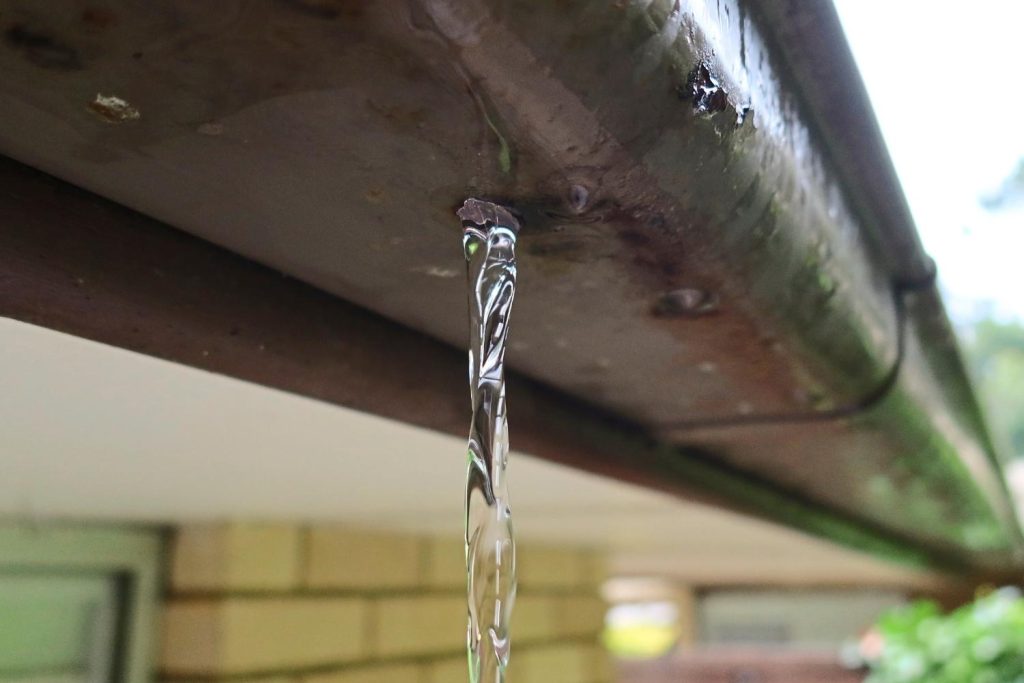
In our experience, gutters can overflow even when there are no leaves, dirt, or debris blocking the system. When that happens, the problem is usually not what is sitting in the gutter, but how water moves through the system, how the gutters are attached, or how rainwater runs off the roof.
Whether the water spills over the front edge or runs behind the gutter, it can collect near the foundation, splash against siding, wash out landscaping, soak fascia boards, and lead to rot or moisture problems around the home.
These problems often show up during heavy rain, which makes them easy to miss until damage has already started. In this article, we’ll share the common causes of gutter overflow when gutters aren’t clogged and how we address each issue.
Causes of Gutters Overflowing When They Are Not Clogged
If your gutters are clean but still overflowing, the problem is usually related to slope, support, capacity, roof design, or installation. In other words, the water may have a clear path, but the gutter system is still not directing it properly.
Here are the most common causes we see:
1. The Gutters Are Too Small for the Roof
Many homes are built with standard five-inch gutters. While that size may work for some rooflines, it can struggle on larger homes, steep roofs, long gutter runs, or roof sections where a lot of water is funneled into one area.
During heavy storms, the roof can shed more water than the gutter trough can carry.
When the volume of water coming off the roof exceeds what the gutter can hold, the excess water has nowhere to go but over the edge. No amount of cleaning changes that because the gutter itself is the limit.
How we fix it:
We look at the roof size, pitch, the length of each gutter run, and how much water is directed into each section. If the system is undersized, we may recommend upgrading to larger gutters, larger downspouts, or both. In many cases, six-inch gutters with larger downspouts provide greater capacity and help prevent overflow during heavy rain.
2. There Are Too Few Downspouts, or the Downspouts Are Too Small
Even if the gutters are the right size, they can still overflow if the water does not have enough ways to leave the system. A long gutter run with one small downspout may collect water faster than it can drain it.
You may notice this when water backs up and spills at the far end of a gutter run, at a corner, or near a downspout. The gutter itself may look clean, but the water is not exiting fast enough.
A good general rule is to have one downspout for every twenty-five to thirty-five feet of gutter, depending on the roofline and how much water the area receives. Downspout size matters too. Narrow two-by-three-inch downspouts do not move water as quickly as larger three-by-four-inch downspouts.
When the gutter fills faster than the downspouts can empty it, the result looks like a gutter problem. In many cases, the real issue is limited drainage capacity.
How we fix it:
We check the number, size, and placement of the downspouts. If one downspout is handling too much water, we may add another outlet. If the downspouts are too small, we may recommend upgrading to larger ones so water can leave the gutter system more quickly.
3. The Gutters Have Lost Their Pitch
Gutters need a slight slope toward the downspout so water keeps moving. If the gutter is too flat, pitched the wrong way, or has shifted over time, water can sit in the trough instead of draining.
The sign of a pitch problem is usually consistent overflow in the same spot every time it rains. You may also see standing water in the gutter after the storm has passed, or a dirt line left behind where water has been sitting.
Gutters can lose their pitch for several reasons. Hangers may loosen, fasteners may back out, fascia boards may soften, or the original installation may not have been set correctly. Even a small change in angle can create a low spot where water collects.
Once water pools in that low area, the gutter is already partially full before the next rain begins. During a storm, that section fills quickly and spills over.
How we fix it:
We check the gutter run’s slope and reset it so that water flows toward the downspout. On longer runs, this may mean re-hanging the entire section to ensure the pitch is consistent from end to end. If hangers are worn, loose, or spaced too far apart, we replace or adjust them so the gutter can hold the correct slope.
4. The Gutters Are Sagging or Pulling Away
A gutter can be clean and still overflow if it is sagging. When part of the gutter dips lower than the rest of the run, water collects in that low spot instead of flowing toward the downspout. Once that low area fills, water spills over the edge.
You can often see this from the ground. The gutter line may look uneven, wavy, or tilted. There may be a visible gap between the back of the gutter and the fascia board. Overflow often happens right where the gutter dips or pulls away from the house.
Sagging gutters are usually caused by loose hangers, backed-out fasteners, heavy standing water, wet debris, or fascia boards that have started to soften or rot. Once a gutter begins to pull loose, the problem often gets worse because more strain is placed on the remaining hangers.
How we fix it:
We re-secure the gutter with proper hangers, correct the spacing, and reset the pitch so water drains correctly. If the fascia behind the gutter has rotted, that wood needs to be repaired or replaced first. New hangers will not hold properly if they are fastened into soft or damaged fascia.
5. Water Runs Behind the Gutter Instead of Into It
Sometimes the gutter is not overflowing over the front edge at all. The water is running behind the gutter.
This can happen when the roof edge, drip edge, or gutter placement is not directing water into the trough. If there is no drip edge, if the drip edge is installed incorrectly, or if the gutter is hanging too low, water can cling to the roof edge and run down behind the gutter instead of dropping into it.
This issue can be hard to spot from the ground because the gutter may look clean and may even drain properly. The damage usually shows up behind and below the gutter. You may notice stained fascia boards, peeling paint, wet soffits, water marks on the siding, or wood rot along the gutter line.
Because the water is bypassing the gutter system completely, it can soak the areas the gutters are supposed to protect.
How we fix it:
We inspect the roof edge, drip edge, and gutter height. If the gutter is too low, we reset it so that water enters the trough properly. If the drip edge is missing or not directing water properly, the issue needs to be corrected so water is directed into the gutter rather than behind it. If the fascia has already rotted, the damaged wood must be replaced before the gutter can be rehung correctly.
6. Water Is Overshooting the Gutter From a Steep Roof or Valley
On a steep roof, water can run off so quickly that it shoots past the front lip of the gutter rather than dropping into the trough. This can happen even when the gutter is clean, pitched correctly, and in good condition.
Roof valleys can create the same problem. A valley collects water from two roof slopes and sends it into one concentrated area. During heavy rain, water can hit the gutter with enough force to splash over the edge or miss it completely.
The sign is usually very specific. The overflow happens in one spot, often below a roof valley, near a corner, or along the steepest section of the roof. The rest of the gutter system may work fine, but that one area turns into a waterfall during heavy rain.
How we fix it:
We look at where the water is coming off the roof and how it is entering the gutter. Depending on the situation, we may install a splash guard or diverter to catch the fast-moving water and direct it into the gutter. In other cases, we may adjust the gutter position, add a nearby downspout, or upgrade that section to handle the concentrated flow.
7. An Upper Roof or Downspout Is Dumping Too Much Water Into One Area
Some overflow problems stem from how water is routed across the roof. An upper roof section, upper gutter, or upper downspout may be dumping a large amount of water onto a lower roof or into one small section of gutter.
When that happens, the lower gutter may not be clogged or damaged. It is simply receiving too much water in one place at one time. This is common in homes with complex rooflines, multiple levels, additions, or roof sections that drain into one concentrated area.
You may notice overflow where an upper downspout empties onto the roof, where a lower gutter receives water from several roof planes, or where one section always seems overwhelmed during heavy rain.
How we fix it:
We look at how water is being routed from the upper roof areas to the lower gutter system. The fix may involve redirecting an upper downspout, adding another downspout, moving the discharge point, installing a splash guard, or upgrading the lower gutter section to handle the extra flow.
8. Gutter Guards Are Shedding Water in Heavy Rain
Gutter guards can help keep debris out, but the wrong style or a poor fit can also keep water out. If water is sheeting over the guard and spilling past the gutter edge, the gutter beneath may be clean even as the system still overflows.
The cause depends on the type of guard. Some solid covers rely on water wrapping around a curved edge before entering the gutter. During heavy rain, fast-moving water can skip past that curve and overshoot the gutter. Mesh and micro-mesh guards can also shed water if pine needles, roof grit, seed pods, or wet leaves build up on top, blocking the openings.
This can be confusing because it looks like a clog from the ground. Water is running over the gutter, but the trough itself may be clear.
How we fix it:
We inspect the gutter guards to see whether water is actually entering the gutter. Sometimes the guards need to be cleaned, adjusted, or re-secured. Other times, a different guard style may be a better fit for the home, especially under heavy tree coverage or below steep roof sections and valleys.
9. The Gutter Trough Is Clean, but the Downspout or Drain Line Is Blocked
This is the one clog-related issue worth mentioning in an article about clean gutters. The gutter trough may be clear, but the water path may still be blocked lower in the system.
A clog can sit inside a downspout elbow, inside the vertical downspout, or in an underground drain line. When that happens, water backs up into a gutter that looks perfectly clean from above. If overflow is happening near a downspout, this should be ruled out before assuming the gutter is undersized or improperly installed.
One common sign is little or no water exiting the bottom of the downspout during rain, even when the gutter above it is full. Another sign is overflow near the outlet where the gutter connects to the downspout.
How we fix it:
We flush the downspout and check whether water drains freely from top to bottom. If the blockage is packed in an elbow or a vertical run, we clear it or take the downspout apart as needed. If the issue is in an underground drain line, that drain may need to be cleared or redirected so the gutter system has a working exit point.
How to Prevent Gutters From Overflowing When They Are Not Clogged
Clean gutters can still overflow if they are too small, pitched incorrectly, poorly supported, or not set up to handle the way water comes off your roof.
The best way to prevent the problem is to make sure water can do three things: enter the gutter properly, move through the gutter without pooling, and drain out through the downspouts fast enough.
Here are the most important ways to prevent clean gutters from overflowing.
- Make sure your gutters are the right size for your roof: If your gutters overflow during heavy rain even when they are clean, the system may not have enough capacity. Larger homes, steep rooflines, long runs, and heavy roof valleys often need a larger gutter system. In many cases, upgrading from standard five-inch gutters to six-inch gutters gives the system more room to handle heavy rainfall.
- Add or upgrade downspouts when needed: Gutters can only work if water has a fast way out. If a long run has too few downspouts, or if the downspouts are too small, water can back up and spill over the edge. Adding another downspout or upgrading to larger downspouts can help the system drain more quickly during heavy rain.
- Keep the gutters pitched correctly: Gutters need a slight slope toward the downspouts. If the pitch is too flat, water sits in the trough. If the pitch is wrong, water may collect in the wrong area. Checking and correcting the slope can prevent standing water, repeated overflow, and extra weight on the system.
- Repair sagging sections before they get worse: A sagging gutter creates a low spot where water collects. Even if the gutter is clean, that low area can fill up and overflow. Loose hangers, backed-out fasteners, and soft fascia boards should be repaired before the gutter pulls farther away from the house.
- Make sure water is actually entering the gutter: Sometimes water runs behind the gutter or overshoots it completely. This can happen when the drip edge is missing or installed incorrectly, when the gutter is hanging too low, or when fast-moving water comes off a steep roof or valley. Correcting the gutter placement, drip edge, or adding splash guards can help direct water into the system instead of behind it or over it.
- Use splash guards in problem areas: If overflow only happens below a roof valley or steep section, the issue may be water coming off the roof too fast. Splash guards or diverters can help catch that concentrated flow and direct it into the gutter where it belongs.
- Choose gutter guards carefully: Gutter guards can help reduce debris buildup, but the wrong style can cause water to run over the top during heavy rain. This is especially common on steep roofs, under heavy tree coverage, or below valleys. If guards are contributing to overflow, they may need to be cleaned, adjusted, or replaced with a better option for the home.
- Watch the gutters during a hard rain: Many overflow problems only show up during heavier storms. Watching where the water escapes can help identify the real cause. Overflow along a full run may point to undersized gutters. Overflow in one spot may point to a sag, pitch problem, valley, or splash issue. Water behind the gutter may point to a drip-edge or installation problem.
- Schedule an inspection if cleaning does not fix the issue: If your gutters are clean and water is still spilling over, the problem usually needs more than another cleaning. A professional inspection can determine whether the issue is related to pitch, sizing, downspouts, fascia, drip edge, gutter guards, or roof runoff.
If they keep overflowing, the system may need to be adjusted, repaired, or upgraded so it can handle the way water actually moves off your roof.
Fix Gutter Overflow Problems With SureFlow Gutters
If your gutters are overflowing but not clogged, there may be a problem with the size, slope, support, downspouts, drip edge, or overall layout of the system. At SureFlow Gutters, we can inspect your gutters, find the cause of the overflow, and recommend the right fix for your home.
Whether the solution is adjusting the pitch, adding downspouts, repairing loose sections, installing splash guards, or upgrading to a larger gutter system, addressing the issue early can help prevent water damage around your foundation, siding, fascia, and landscaping.
Call us at 864-265-9888 or schedule your free inspection online, and we’ll find out exactly why your gutters are overflowing and what it will take to fix it.